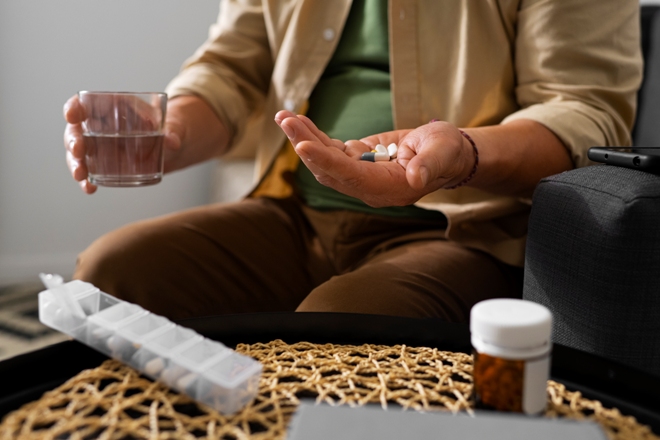
Photo Credit: by freepik.com
If your antidepressant lifted your mood but flattened your sex life, you’re not imagining it, and you’re not alone. Sexual side effects (such as low desire, arousal problems, erectile dysfunction, delayed or difficulty with orgasm, or reduced genital sensation) are often reported with selective serotonin reuptake inhibitor (SSRI) antidepressants. A large meta-analysis found high rates across the class, with some medications causing sexual side effects in up to 80% of people.
But the good news is that you have options. Below, you’ll find why antidepressants have sexual side effects, how antidepressants compare, and concrete, evidence-backed ways to fix the problem, without sacrificing your mental health.
Why SSRIs Affect Sex (and Why Bupropion/Mirtazapine Often Don’t)
Selective serotonin reuptake inhibitors (SSRIs) are a type of antidepressant that broadly increase the neurotransmitter serotonin. That’s good for mood and anxiety, but in sexual pathways, over-activation of certain serotonin subreceptors (like 5-HT2 and 5-HT3) can dampen desire, blunt arousal, and delay or prevent orgasm. Part of the problem is that these medications can turn down what’s commonly thought of as your brain’s reward signal (dopamine), so desire and pleasure feel muted. They can also disrupt a natural chemical (nitric oxide) that tells blood vessels to open up, which makes genital blood flow and arousal harder. (See more about the mechanisms of SSRI-induced sexual dysfunction, here.)
However, antidepressants from other classes work a little bit differently. Examples like bupropion (Wellbutrin) and mirtazapine (Remeron) are known to reduce the risk of sexual side effects.
• Bupropion boosts norepinephrine and dopamine with minimal direct serotonergic action, which helps preserve libido and orgasm. Across trials and meta-analyses, it carries lower sexual side effect rates than SSRIs.
• Mirtazapine blocks serotonin subreceptors and enhances noradrenergic tone, translating clinically to fewer orgasm delays and less orgasm difficulty versus many SSRIs.
How Common and Severe Are Sexual Side Effects by Medication?
Here are some examples of common antidepressant medications and how they fare in regard to sexual side effects.
For more information on the prevalence of sexual side effects for various antidepressants, see here.
What You Can Do, Step-by-Step, Based on the Evidence
If you suspect your antidepressant is affecting your sex life, there are many steps you can take.
1. Name and track the side effects.
Yes, many antidepressant side effects go away with time, but some patients do not spontaneously adapt to SSRI-related sexual effects. You don’t need to worry if it’s only week one, but if you’re still seeing sexual side effects after a month, start a simple tracker for two to three weeks. Track desire (0–10), arousal (0–10), orgasm success (%), and pain/dryness (0–10). Also note medication dose and time, alcohol consumption, and any life stress you may be experiencing. Bring this to your next appointment.
What you might ask your doctor:
“Since starting medication 20 mg of medication X, my libido is down about 70% and I can’t reach orgasm on most attempts. Here are three weeks of notes. Can we adjust my treatment plan so I keep the mood benefits but get my sex life back?”
2. Optimize at the lowest effective dose.
Sexual side effects often increase when the dose does. If your mood is stable, your clinician may consider a gradual reduction to the lowest effective dose, with a plan to reverse course if depressive symptoms return. Remember, do not do this on your own. Medical oversight is important.
What you might ask your doctor:
“Could we test a small, careful reduction and monitor mood and sexual function every two to four weeks to see when the side effects diminish?”
3. Try a timing change.
Change when you take your antidepressant. If you take your medication in the morning, move the SSRI dose to the evening and schedule intimacy earlier in the day to capitalize on the window when side effects feel least noticeable. If you normally take your medication at night, do the reverse. This is a practical, low-risk experiment that can be surprisingly helpful. Do not change the way you take your medication without talking to your doctor first, however.
What you might ask your doctor:
“Is it reasonable to switch to evening dosing so I can try mornings for intimacy for a few weeks?”
4. Switch medications, often out of the SSRI class.
Switching within the SSRI class (e.g., from paroxetine [Paxil] to sertraline [Zoloft]) helps some, but because the mechanism of how SSRI antidepressants work is shared, lateral moves can disappoint at times. If sexual function is a priority, consider switching to bupropion (Wellbutrin) or mirtazapine (Remeron), which consistently show lower sexual side effect rates.
What you might ask your doctor:
“Could we plan a careful switch to bupropion, mirtazapine, or another antidepressant with fewer sexual side effects?”
5. Augment your current medication when the SSRI is working for mood.
You never want to lose a medication if it’s effectively treating your mood. If your SSRI is indispensable, consider add-ons tailored to your main symptoms. Some available options include:
• PDE-5 inhibitors (e.g., sildenafil [Viagra]): Randomized trials show benefit for antidepressant-associated sexual dysfunction in men and women, improving arousal, erectile function, orgasm, lubrication, and satisfaction without destabilizing mood. Information on its use in men can be found here, and in women can be found here.
• Bupropion (Wellbutrin): This is a reasonable option in select patients, particularly for low sexual desire.
• Buspirone (Buspar): This option can be considered, particularly if you are having trouble achieving orgasm.
What you might ask your doctor:
“Since arousal and orgasm are the biggest issues, would a short trial of a PDE-5 inhibitor make sense while keeping my SSRI dose stable?”
6. Consider changing your dosing schedule.
Skipping one to two doses around planned intimacy (i.e., a “drug holiday”) might help some patients on shorter half-life SSRIs like sertraline (Zoloft) and paroxetine (Paxil), but not fluoxetine (Prozac), as it has a long half-life. A similar alternative could be lowering the dose to half for two consecutive days a week prior to having sexual relations, before subsequently continuing with the usual dose. These are often considered last-line options due to withdrawal and relapse risk and symptom rebound. Again, it’s important only to do this with medical oversight.
What you might ask your doctor:
“Would it be possible to stop or lower my dose of my antidepressant temporarily from time to time to facilitate intimacy?”
7. Sex-therapy tools can help regardless of which medication you take.
Remember, there are many factors at play during issues of intimacy. Impact factors outside of the medication by trying these things.
• Schedule intimacy during your peak energy and least medicated window.
• Use lubricant and consider vibrators or suction devices to increase stimulation and genital blood flow.
• Sensate focus and mindfulness-based sexual therapy can reduce performance pressure and rekindle arousal. (See an example of sensate focus here.)
• Look into treating additional complicating factors like sleep problems, chronic pain, alcohol use, and pelvic-floor issues.
• Communicate openly with a partner. When performance pressure drops, satisfaction often rises.
These approaches are considered low-risk and are typically compatible with medication changes. Also, consider seeing a sex therapist either alone or with your partner for additional help.
Sexual Symptoms After Stopping Antidepressants – PSSD
A very small number of people (around 0.46%) report ongoing sexual side effects after stopping SSRIs. This is sometimes called post-SSRI sexual dysfunction (PSSD). Common PSSD symptoms include genital numbness, pleasureless or weak orgasm, decreased sex drive, erectile dysfunction, and premature ejaculation. There is no known definitive treatment yet, but laser irradiation and phototherapy have shown some promising results. Research is ongoing.
FAQs About Antidepressants and Sex
Do sexual side effects fade with time?
Sometimes, but some people do not adapt. If problems persist beyond four to six weeks at a stable dose, move to active management of the side effects rather than waiting indefinitely.
Is paroxetine (Paxil) uniquely bad?
Across comparative datasets, paroxetine repeatedly shows higher rates and severity of sexual dysfunction than many peers.
Are bupropion or mirtazapine sex side effect-neutral?
No drug is universally side effect-free, but both tend to have lower sexual side effect rates than SSRIs, and switching to them often improves libido and orgasm.
What if erection or lubrication is the main problem?
If either of those is your main concern, ask about a PDE-5 inhibitor such as sildenafil (Viagra); controlled trials support their use in antidepressant-associated sexual dysfunction for men and women.
Should I just stop the SSRI?
You should never stop your medication without the help of your doctor. Abrupt discontinuation risks withdrawal and relapse, and doesn’t guarantee that sexual function will rebound immediately. Work with your clinician on a measured plan.
Bottom Line: You Don’t Have to Choose Between Mood and Intimacy
If an antidepressant has quieted your depression but dimmed your sex life, you’re not alone, and you’re not stuck with an unsatisfying sex life. Sexual side effects are common with SSRIs, but they’re also manageable. Start by naming and tracking what’s happening, then work with your clinician on low-risk tweaks like dose optimization and timing, evidence-backed changes like switching to bupropion or mirtazapine when appropriate, or targeted add-ons such as a PDE-5 inhibitor for arousal, erection, or lubrication issues. Reserve last-line options (like supervised “drug holidays”) for select cases and never stop medication abruptly. With a few focused adjustments and honest communication with your partner, you can protect your mental health and restore a satisfying sex life.
Sources
1. Bala, A., Nguyen, H. M. T., & Hellstrom, W. J. (2018). Post-SSRI Sexual Dysfunction: A Literature Review. Sexual Medicine Reviews, 6(1), 29–34. https://doi.org/10.1016/j.sxmr.2017.07.002
2. Ben-Sheetrit, J., Hermon, Y., Birkenfeld, S., Gutman, Y., Csoka, A. B., & Toren, P. (2023). Estimating the risk of irreversible post-SSRI sexual dysfunction (PSSD) due to serotonergic antidepressants. Annals of General Psychiatry, 22(1), 15. https://doi.org/10.1186/s12991-023-00447-0
3. Higgins, A. (2010). Antidepressant-associated sexual dysfunction: impact, effects, and treatment. Drug Healthcare and Patient Safety, 2, 141. https://doi.org/10.2147/dhps.s7634
4. Keltner, N. L., McAfee, K. M., & Taylor, C. L. (2009). Mechanisms and Treatments of SSRI-Induced Sexual Dysfunction. Perspectives in Psychiatric Care, 38(3), 111–116. https://doi.org/10.1111/j.1744-6163.2002.tb00665.x
5. Montejo, A., Prieto, N., De Alarcón, R., Casado-Espada, N., De La Iglesia, J., & Montejo, L. (2019). Management Strategies for Antidepressant-Related Sexual Dysfunction: A Clinical Approach. Journal of Clinical Medicine, 8(10), 1640. https://doi.org/10.3390/jcm8101640
6. Moses, S. (2025, January 11). Antidepressant induced sexual dysfunction. Family Practice Notebook. Retrieved November 10, 2025, from https://mobile.fpnotebook.com/Psych/Pharm/AntdprsntIndcdSxlDysfnctn.htm
7. Nurnberg, H., Hensley, P., & Gelenberg, A. (2003). Treatment of Antidepressant-Associated Sexual Dysfunction With Sildenafil. JAMA, 289(1), 56–64. https://doi.org/10.1001/jama.289.1.56
8. Nurnberg, H. G., Hensley, P. L., Heiman, J. R., Croft, H. A., Debattista, C., & Paine, S. (2008). Sildenafil Treatment of women with Antidepressant-Associated Sexual Dysfunction. JAMA, 300(4), 395. https://doi.org/10.1001/jama.300.4.395
9. Serretti, A., & Chiesa, A. (2009). Treatment-Emergent Sexual Dysfunction Related to Antidepressants. Journal of Clinical Psychopharmacology, 29(3), 259–266. https://doi.org/10.1097/JCP.0b013e3181a5233f